
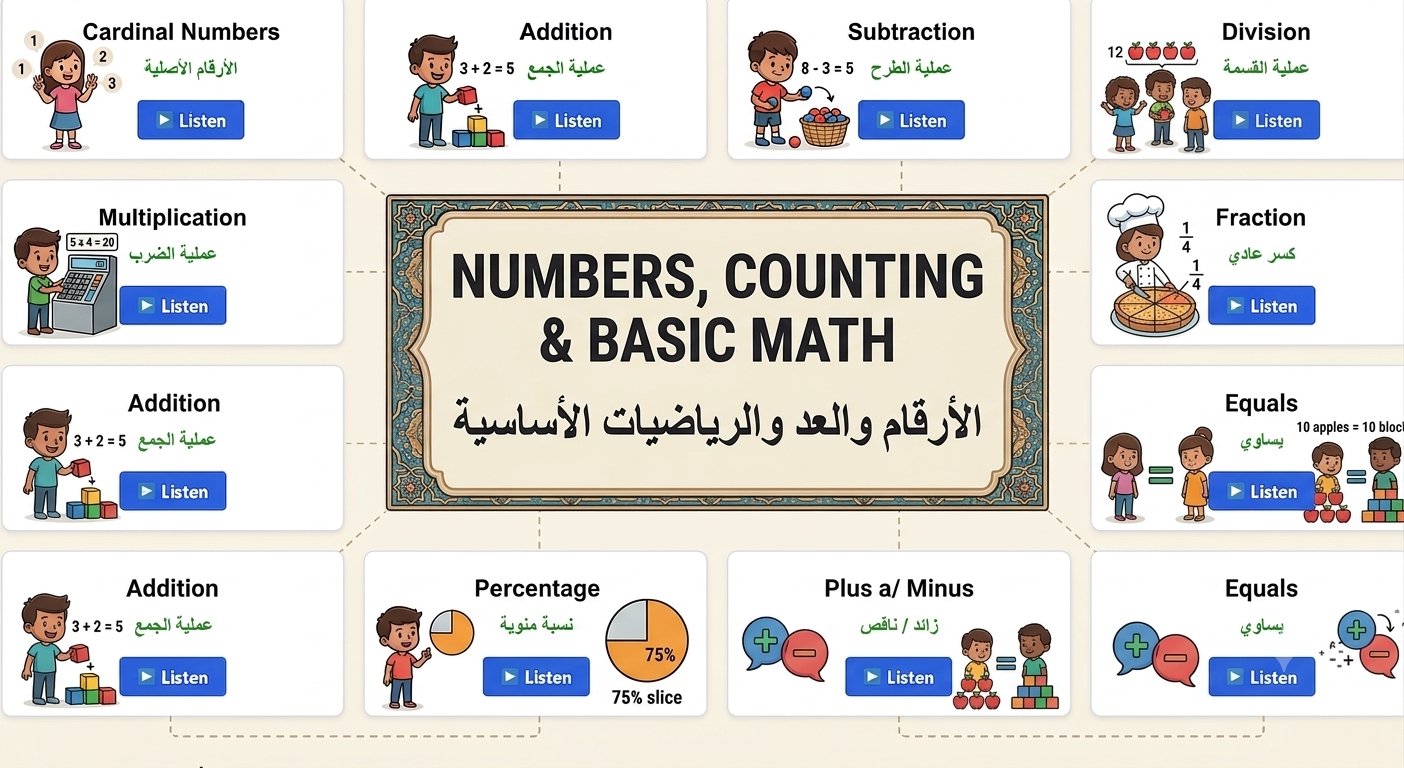
تعلم اللغة الإنجليزية : 3 – الأرقام والعد والرياضيات الأساسية
Mastering numbers (إتقان الأرقام), counting techniques (تقنيات العد), and basic mathematical expressions (التعابير الرياضية الأساسية) forms the bedrock of daily communication in English. Whether you are shopping at a store, inquiring about prices (الاستفسار عن الأسعار), telling the time, or performing simple calculations (إجراء حسابات بسيطة), knowing how to use numbers accurately is indispensable. In this comprehensive guide, you will learn the foundational rules for counting, understand the distinction between cardinal and ordinal numbers, explore basic arithmetic grammar, and practice with 15 interactive vocabulary cards featuring audio pronunciation.
Grammar Focus: Rules for Using Numbers in English
Understanding the grammatical rules behind numbers prevents common errors in writing and conversation. Here are the core structural guidelines:
- 1. Cardinal vs. Ordinal Usage (الأرقام الأصلية مقابل الترتيبية):
- Cardinal numbers (one, two, hundred, thousand) answer the question “How many?” Example: “I have three books.”
- Ordinal numbers (first, second, third, twentieth) specify sequence or position (الترتيب أو المركز). Always place the definite article “the” before ordinal numbers. Example: “He won the first place.”
- 2. Singular and Plural Rules with Large Numbers (قواعد المفرد والجمع مع الأرقام الكبيرة):
- Words like hundred, thousand, and million remain singular when preceded by a specific number. Correct: “five hundred people” (NOT five hundreds).
- Use the plural form + “of” only when referring to an indefinite large quantity (كمية غير محددة). Correct: “Thousands of students attended.”
- 3. Expressing Math Operations (التعبير عن العمليات الحسابية):
- For addition: Use “plus” or “added to”. Example: “5 + 5 = 10” (Five plus five equals ten).
- For subtraction: Use “minus” or “subtracted from”. Example: “10 – 4 = 6” (Ten minus four is six).
- Verb agreement: Simple math equations take a singular verb (is or equals).
Understanding Numbers in Daily Life Contexts
Numbers appear constantly in everyday communication. Knowing how to pronounce and apply them in different scenarios ensures natural fluency:
- Handling Currency and Prices (التعامل مع العملات والأسعار): When reading prices in English, express the whole number first, followed by the decimal or currency unit. For example, $15.50 is read as “fifteen dollars and fifty cents” or simply “fifteen fifty”.
- Fractions and Decimals (الكسور والأعداد العشرية): Express fractions by using a cardinal number for the numerator (البسط) and an ordinal number for the denominator (المقام), such as “one-third” (1/3) or “two-fifths” (2/5). For decimals, always pronounce the period as “point” and state each digit individually after it (e.g., 4.25 is “four point two five”).
- Quantifying Groups (تحديد كميات المجموعات): Distinguish between even numbers (أرقام زوجية divisible by 2) and odd numbers (أرقام فردية). When increasing quantities, use terms like double (مضاعفة مرتين) or triple (ثلاثة أضعاف) to articulate growth clearly.
Real-Life Practical Dialogue Example
Here is a realistic dialogue demonstrating numbers, calculations, and purchasing in a shop:
- Shopkeeper: Good morning! How can I help you today?
- Customer: Hello! I would like to buy three notebooks and two pens, please.
- Shopkeeper: Certainly. Each notebook is four dollars, and the pens are two dollars each.
- Customer: So the total amount for the notebooks is twelve dollars, plus four dollars for the pens?
- Shopkeeper: Exactly! Twelve plus four equals sixteen dollars in total.
- Customer: Great, here is a twenty-dollar note.
- Shopkeeper: Thank you! Here is your change: four dollars. Have a wonderful day!
📝 تمارين تفاعلية | Practice Exercises – Lesson 3
Lesson Conclusion
Congratulations! You have successfully completed Lesson 3.
In this lesson, you mastered counting, learned the difference between cardinal and ordinal numbers, explored basic mathematical operations, and practiced using numbers in real-world situations like shopping and reading prices.
- Tip of the Day: Try calculating simple expenses or counting daily items in English—such as “two cups of coffee” or “ten dollars”—to sharpen your number fluency.
Thank you for your effort! Keep building your confidence, and see you in Lesson 4.