
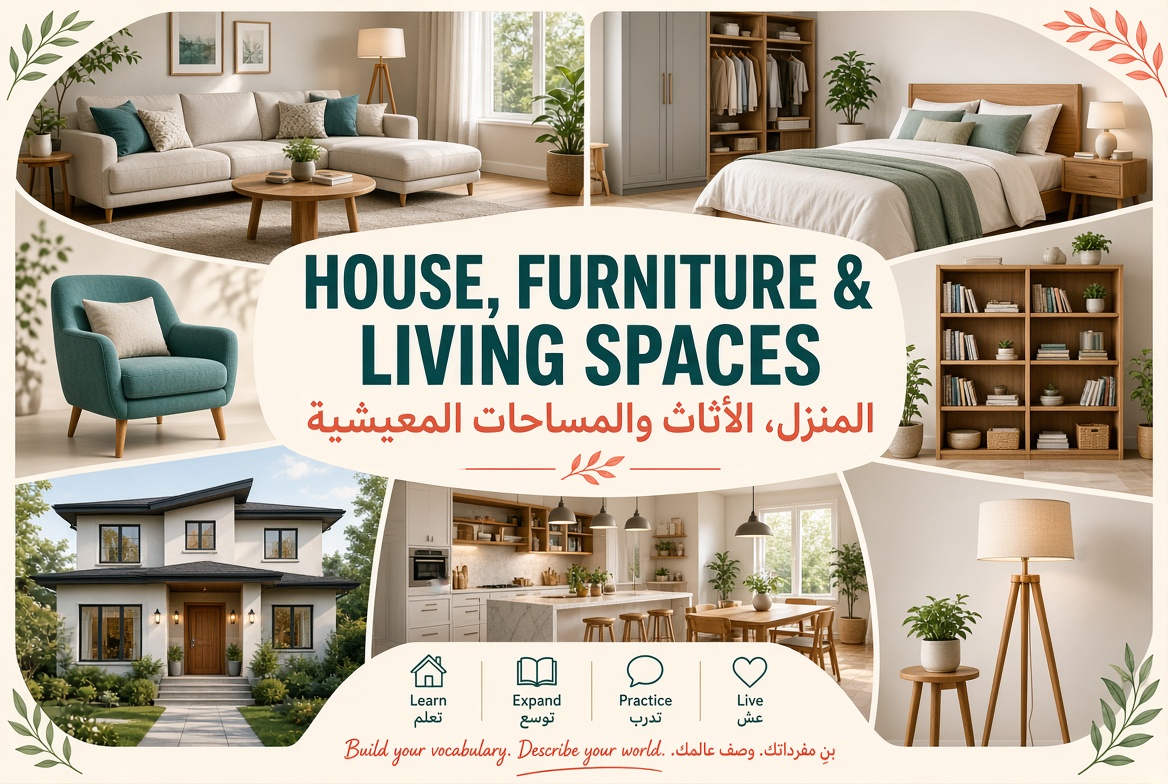
تعلم اللغة الإنجليزية : الدرس التاسع – المنزل، الأثاث والمساحات المعيشية
Describing your home (وصف منزلك) and talking about everyday living spaces (والحديث عن المساحات المعيشية اليومية) requires essential vocabulary (يتطلب مفردات أساسية) that helps you express your environment clearly (تساعدك على التعبير عن بيئتك بوضوح). Whether you are moving to a new apartment (سواء كنت تنتقل إلى شقة جديدة), buying furniture for your room (أو تشتري أثاثاً لغرفتك), or inviting friends over (أو تدعو أصدقاءك للزيارة), knowing house-related terms is fundamental (فإن معرفة المصطلحات المتعلقة بالمنزل أمر أساسي). In this lesson, you will learn 15 common house items (ستتعلم 15 مفردة شائعة خاصة بالمنزل), explore prepositions of place (وتستكشف حروف الجر الخاصة بالمكان), practice useful dialogues (وتتدرب على محادثات مفيدة), and interact with audio cards (وتتفاعل مع بطاقات صوتية تفاعلية).
Grammar Focus: Prepositions of Place & “There is / There are”
When describing a house and placing objects, we use There is / There are along with Prepositions of Place (حروف الجر الخاصة بالمكان).
- 1. “There is” vs. “There are” (يوجد / يوجد للمفرد والجمع):
- Use There is for singular nouns (للمفرد):
- Example: “There is a table in the kitchen.” (يوجد طاولة في المطبخ)
- Use There are for plural nouns (للجمع):
- Example: “There are two chairs in the room.” (يوجد كرسيان في الغرفة)
- Use There is for singular nouns (للمفرد):
- 2. Essential Prepositions of Place (حروف الجر المكانية الأساسية):
- In (في / داخل): Used for enclosed spaces or rooms.
- Example: “The food is in the refrigerator.”
- On (على / فوق السطح): Used when an object touches a surface.
- Example: “The lamp is on the table.”
- Under (تحت): Used when an object is lower than something else.
- Example: “The cat is sleeping under the bed.”
- Next to (بجانب): Used when objects are side by side.
- Example: “The armchair is next to the sofa.”
- Between (بين): Used when an object is located in the middle of two things.
- Example: “The table is between two chairs.”
- In (في / داخل): Used for enclosed spaces or rooms.
Describing Your Living Space and Rooms
When talking about your home in everyday English, you typically group furniture and items according to the specific room they belong to:
- The Living Room (غرفة المعيشة): This is usually the main area for relaxation and receiving guests. Key items include a sofa, armchair, carpet, and curtains.
- Example: “Our living room is bright because it has big windows with blue curtains.”
- The Kitchen (المطبخ): Used for preparing meals. Essential appliances and features include the refrigerator, dining table, and storage cabinets.
- Example: “We store vegetables in the refrigerator and eat breakfast at the kitchen table.”
- The Bedroom (غرفة النوم): A personal space dedicated to resting. Common objects are the bed, wardrobe, and a side table.
- Example: “I keep my coats organized inside the wardrobe in my bedroom.”
Everyday Dialogue: Showing a Friend Your New Apartment
Here is a short, simple dialogue between two friends discussing home layout:
- Sarah: Welcome to my new apartment! Let me show you around.
- Omar: Thank you! Wow, your living room looks very spacious.
- Sarah: Thanks. There is a comfortable sofa next to the window, and a red carpet on the floor.
- Omar: Where is the kitchen located?
- Sarah: It is right next to the living room. There is a large refrigerator and a small dining table.
- Omar: Very nice! And do you have a balcony?
- Sarah: Yes, there is a small balcony near the bedroom where I like to sit in the morning.
Lesson Conclusion
Congratulations! You have successfully completed Level 1 – Lesson 9.
In this lesson, you mastered essential vocabulary for household items and rooms: Kitchen, Bedroom, Living room, Bathroom, Sofa, Bed, Table, Chair, Refrigerator, Curtains, Wardrobe, Balcony, Mirror, Carpet, and Armchair. Furthermore, you learned how to locate objects using prepositions of place and the structure “There is / There are”.
- Tip of the Day: Practice describing your own room aloud in English today! For example: “There is a bed next to the wardrobe, and my books are on the table.”
Fantastic job! See you in Lesson 10.