
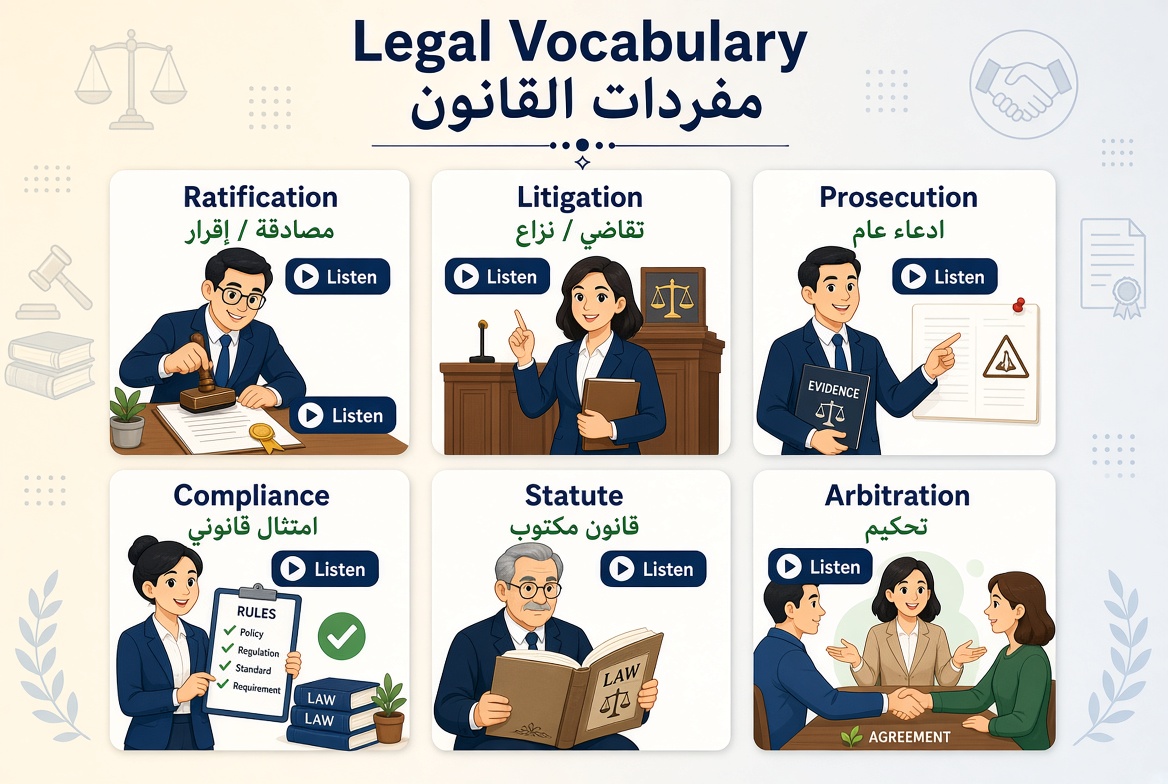
تعلم اللغة الإنجليزية : الدرس الثامن – القانون، الأنظمة القانونية وحقوق الإنسان
Understanding legal systems (فهم الأنظمة القانونية), human rights frameworks (أطر حقوق الإنسان), and judicial procedures (الإجراءات القضائية) is essential for mastering high-level professional English. Whether navigating international treaties (المعاهدات الدولية), analyzing legal compliance (الامتثال القانوني), or participating in formal debates on fundamental freedoms (الحريات الأساسية), precise legal vocabulary is indispensable. In this advanced lesson, you will explore 15 audio-enabled vocabulary cards, study complex passive voice structures used in legal drafting, read an authoritative discussion on civil liberties, and complete 6 rigorous practice exercises.
Grammar Focus: Formal Legal Structures & Passive Voice in Legal Drafting
Legal English relies on objective, formal structures to emphasize actions, outcomes, and rules rather than specific individuals:
- 1. Formal Passive Voice (المبني للمجهول في النصوص القانونية):
- Structure: Subject + Modal/Auxiliary + Be + Past Participle
- Used to state universal legal conditions, obligations, and prohibitions objectively:
- Example: “All citizens shall be guaranteed protection under fundamental constitutional laws.” (يُكفل لجميع المواطنين الحماية بموجب القوانين الدستورية الأساسية)
- Example: “The contract was terminated due to a breach of statutory compliance.” (تم إنهاء العقد بسبب خرق الامتثال القانوني)
- 2. Prepositional Phrases & Legal Connectives (الروابط والعبارات الاصطلاحية القانونية):
- Structure: In accordance with / Subject to / Pursuant to
- Used to establish legal authority and compliance:
- Example: “Pursuant to Article 5, the defendant reserved the right to appeal.” (عملاً بالمادة 5، احتفظ المدعى عليه بحق الاستئناف)
- Example: “The terms apply in accordance with international humanitarian standards.” (تُطبق الشروط وفقاً للمعايير الإنسانية الدولية)
Navigating Judicial Systems and Fundamental Human Rights
Understanding high-level legal terms enables you to evaluate international treaties, legal proceedings, and human rights frameworks with precision:
- Legislative and Judicial Frameworks (الأطر التشريعية والقضائية): The creation of laws relies on formal legislation passed by governing bodies. Once statutes are enacted, courts exercise jurisdiction to interpret laws through jurisprudence and resolve disputes through litigation or neutral arbitration.
- Human Rights and Legal Compliance (حقوق الإنسان والامتثال القانوني): Protecting human dignity requires strict adherence to international human rights standards. When an infringement of civil rights occurs, legal systems issue remedies—such as an injunction or financial sanctions—to ensure strict regulatory compliance.
Advanced Legal Analysis: Discussion on Human Rights Legislation
Here is an authoritative exchange between an international human rights lawyer (Dr. Vance) and a legal consultant (Mr. Aris):
- Dr. Vance: Pursuant to recent international reports, several nations have failed to ensure full compliance with human rights conventions.
- Mr. Aris: That is correct. In many instances, national legislation conflicts with international treaties that underwent formal ratification years ago.
- Dr. Vance: What legal mechanisms can be deployed when an infringement of fundamental liberties occurs within a state’s jurisdiction?
- Mr. Aris: Victims may initiate litigation before international tribunals once domestic remedies are exhausted.
- Dr. Vance: Does the tribunal possess the authority to issue a binding injunction against non-compliant states?
- Mr. Aris: Indeed. While enforcement relies on diplomatic cooperation, judicial verdicts carry significant weight under customary jurisprudence.
Lesson Conclusion
Congratulations! You have successfully completed Level 3 – Lesson 8: Law, Legal Systems & Human Rights.
In this advanced lesson, you mastered 15 legal terms including Jurisdiction, Legislation, Ratification, Litigation, Prosecution, Defendant, Jurisprudence, Compliance, Statute, Arbitration, Infringement, Injunction, Sanction, Testimony, and Verdict. You also explored formal passive voice structures and legal connectives essential for legal drafting and policy discussions.
- Tip of the Day: Practice drafting objective legal statements using formal passive structures (e.g., “All procedures shall be conducted pursuant to statutory mandates”) to sharpen your professional English fluency.
Great job! See you in Lesson 9.