
تعلم اللغة الإنجليزية : الدرس الثامن – الروتين اليومي، الوقت والمواعيد
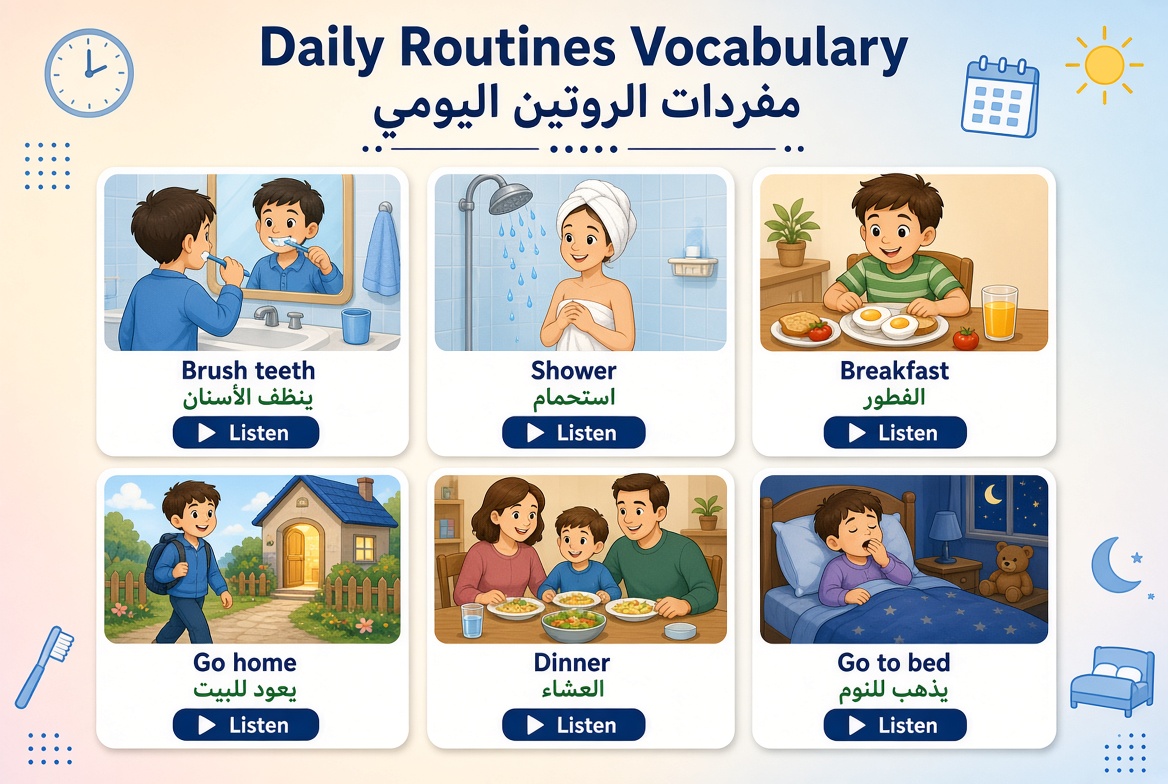
Talking about your daily routine (الروتين اليومي) and telling time (إخبار الوقت) are essential skills for everyday English conversations. Whether you want to describe your morning habits (عادات الصباح), talk about work or school schedules (مواعيد العمل أو المدرسة), or set an appointment (تحديد موعد), learning these basic expressions will help you communicate clearly. In this beginner lesson, you will explore 15 audio-enabled vocabulary cards, learn how to use the Present Simple tense for daily habits, read a simple conversation, and test your knowledge with 6 interactive exercises.
Grammar Focus: Present Simple for Daily Routines & Telling Time
To talk about daily habits and time in English, we use simple present tense structures along with specific time prepositions:
- 1. Talking About Routines (استخدام المضارع البسيط للروتين):
- Use I / You / We / They + Verb:
- Example: I wake up at 7:00 AM. (أستيقظ في السابعة صباحاً)
- Use He / She / It + Verb (+s):
- Example: She gets up early. (هي تنهض مبكراً)
- Use I / You / We / They + Verb:
- 2. Prepositions of Time (حروف الجر الخاصة بالوقت):
- Use at before specific times:
- Example: at 8:00 AM / at noon / at night.
- Use in for parts of the day:
- Example: in the morning / in the afternoon / in the evening.
- Use at before specific times:
- 3. Asking and Telling Time (السؤال عن الوقت وإخباره):
- Question: What time is it? / What’s the time? (كم الساعة؟)
- Answer: It is 9 o’clock. (الساعة التاسعة تماماً)
- Answer: It is 7:30 (seven thirty) / It is half past seven. (الساعة السابعة والنصف)
Understanding Daily Routines and Schedules in Daily Life
Describing your day and managing schedules are basic conversation building blocks:
- Structuring Your Day (ترتيب أحداث اليوم): Daily activities follow a natural sequence: Morning (wake up, brush teeth, eat breakfast), Afternoon (work/school, eat lunch), and Evening/Night (go home, eat dinner, go to bed).
- AM vs. PM (تحديد الفترات الزمانية): Use AM for morning hours (from midnight to 11:59 AM) and PM for afternoon/evening hours (from 12:00 PM noon to 11:59 PM).
Daily English Dialogue Example: Discussing Daily Schedules
Here is a simple conversation between two colleagues talking about their daily schedules:
- David: Good morning, Anna! What time do you usually wake up?
- Anna: Good morning, David! I usually wake up at 6:30 AM.
- David: That is early! What time do you go to work?
- Anna: I leave home at 7:45 AM and arrive at work at 8:15 AM.
- David: When do you eat lunch?
- Anna: I eat lunch at 1:00 PM, and I go home at 5:00 PM.
Lesson Conclusion
Congratulations! You have successfully completed Level 1 – Lesson 8: Daily Routines, Time & Schedules.
In this beginner lesson, you learned 15 essential vocabulary terms including Wake up, Get up, Brush teeth, Take a shower, Eat breakfast, Go to work, Eat lunch, Go home, Eat dinner, Go to bed, Clock, Schedule, Morning, Afternoon, and Evening. You also learned how to state your daily activities and tell time accurately using prepositions like “at” and “in”.
- Tip of the Day: Practice saying your daily schedule out loud each morning (e.g., “I wake up at 7:00 AM”).
Great job! See you in Lesson 9.