
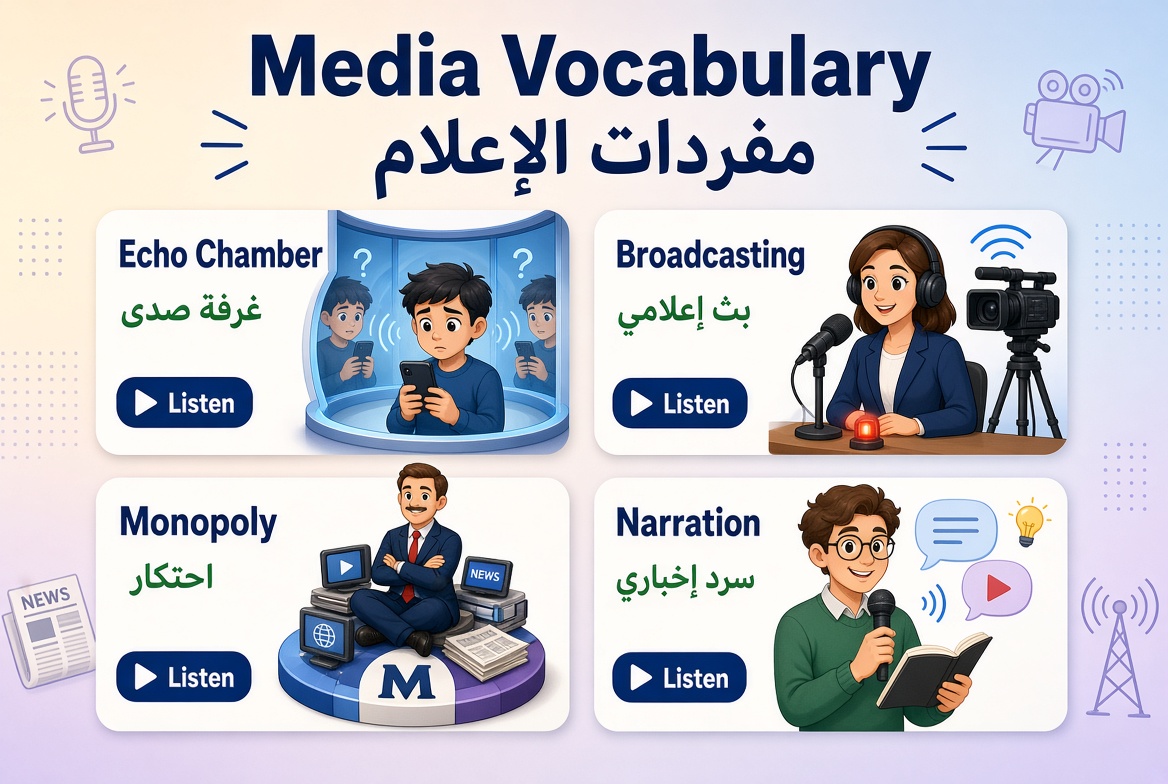
تعلم اللغة الإنجليزية : الدرس السابع – الإعلام، الثقافة الرقمية والاتصال الجماهيري
Navigating contemporary discussions around mass media (وسائل الإعلام الجماهيرية), information dissemination (انتشار المعلومات), and digital journalism (الصحافة الرقمية) demands a sophisticated conceptual vocabulary and critical analytical framing. From analyzing algorithmic echo chambers (غرف الصدى الخوارزمية) and journalistic objectivity (الموضوعية الصحفية) to evaluating digital misinformation (التضليل الرقمي) and media censorship (الرقابة الإعلامية), mastering advanced structures is indispensable. In this advanced lesson, you will explore 15 audio-enabled vocabulary cards, study advanced discourse markers and inverted conditional structures, analyze a formal debate fragment, and test your mastery through 6 interactive exercises.
Grammar Focus: Inverted Conditionals & Nuanced Discourse Markers in Media Analysis
Critical media discourse utilizes high-level inversion techniques and sophisticated connectors to structure persuasive arguments:
- 1. Inverted Conditionals for Hypothetical Policy Scenarios (صيغ الشرط العكسية):
- Removing “if” and inverting the subject and verb adds formal authority to policy analysis:
- Standard: “If regulatory bodies were to intervene, digital platforms would change.”
- Inverted: “Were regulatory bodies to intervene, digital platforms would alter their algorithms.”
- Standard: “If media organizations had verified the source, misinformation would not have spread.”
- Inverted: “Had media organizations verified the source, misinformation would not have spread.”
- 2. Nuanced Discourse Markers for Counter-arguments (روابط الربط الدقيقة):
- Advanced writing replaces generic words like “but” with precise markers that establish concession or contrast:
- Concession: Notwithstanding (بالرغم من) -> “Notwithstanding the rise of decentralized channels, mainstream broadcasting retains vast influence.”
- Contrast: Conversely (على العكس من ذلك) -> “Tabloid media relies on sensationalism; conversely, investigative journalism prioritizes empirical accuracy.”
- 3. Subjunctive Stance in Editorial Writing (صيغة المنصوب للوجوب والأهمية):
- Expressions of urgency demand subjunctive structures (base verb without ‘s’ or ‘ed’):
- Example: “It is vital that news outlets maintain objectivity regardless of commercial pressure.”
Deconstructing Digital Media Culture and Mass Communication Dynamics
Analyzing mass media requires rigorous critical evaluation of source material, algorithmic influence, and narrative framing:
- Evaluating Algorithmic Echo Chambers (تقييم غرف الصدى الخوارزمية): Modern content delivery networks curate feed recommendations based on user engagement metrics. While this optimizes retention, it risks locking audiences into partisan echo chambers, reducing exposure to contrasting views and driving societal polarization.
- Countering Disinformation in Real-time (مواجهة التضليل الممنهج): The rapid virality of digital media often outpaces traditional editorial fact-checking protocols. Combating systematic disinformation requires multi-layered verification mechanisms, combining technological automated detection with human editorial standards.
Academic Media Debate Dialogue Example: Press Regulation vs. Free Discourse
Here is an advanced dialogue between two political communications specialists discussing media governance:
- Dr. Sterling: Were independent regulatory bodies to mandate algorithmic transparency, platform accountability would immediately increase.
- Prof. Vance: Notwithstanding the clear intent of such regulations, over-regulation risks creating institutional censorship that limits journalistic freedom.
- Dr. Sterling: It is crucial that we distinguish between state censorship and necessary safeguards against targeted digital disinformation.
- Prof. Vance: Conversely, who decides which narratives constitute legitimate public opinion and which constitute propaganda?
- Dr. Sterling: Had news agencies maintained strict verification protocols initially, public trust in mass media would not have eroded so severely.
- Prof. Vance: Broad systemic education in media literacy remains a far more effective countermeasure than imposing legal restrictions.
Lesson Conclusion
Congratulations! You have successfully completed Level 3 – Lesson 7: Media, Digital Culture & Mass Communication.
In this advanced lesson, you mastered 15 specialized vocabulary terms including Disinformation, Sensationalism, Echo Chamber, Broadcasting, Censorship, Propaganda, Journalism, Monopoly, Narration, Polarization, Verification, Objectivity, Virality, Infodemic, and Syndication. Additionally, you analyzed inverted conditional structures (Had media organizations verified…) and formal discourse markers designed for editorial writing and political communications discourse.
- Tip of the Day: Employing inverted conditionals (e.g., using “Were platforms to enforce…” instead of “If platforms enforced…”) elevates formal policy writing and conveys high stylistic authority.
Exceptional work! See you in Lesson 8.