
تعلم اللغة الإنجليزية : الدرس الرابع – القضايا البيئية، الاستدامة والعمل المناخي
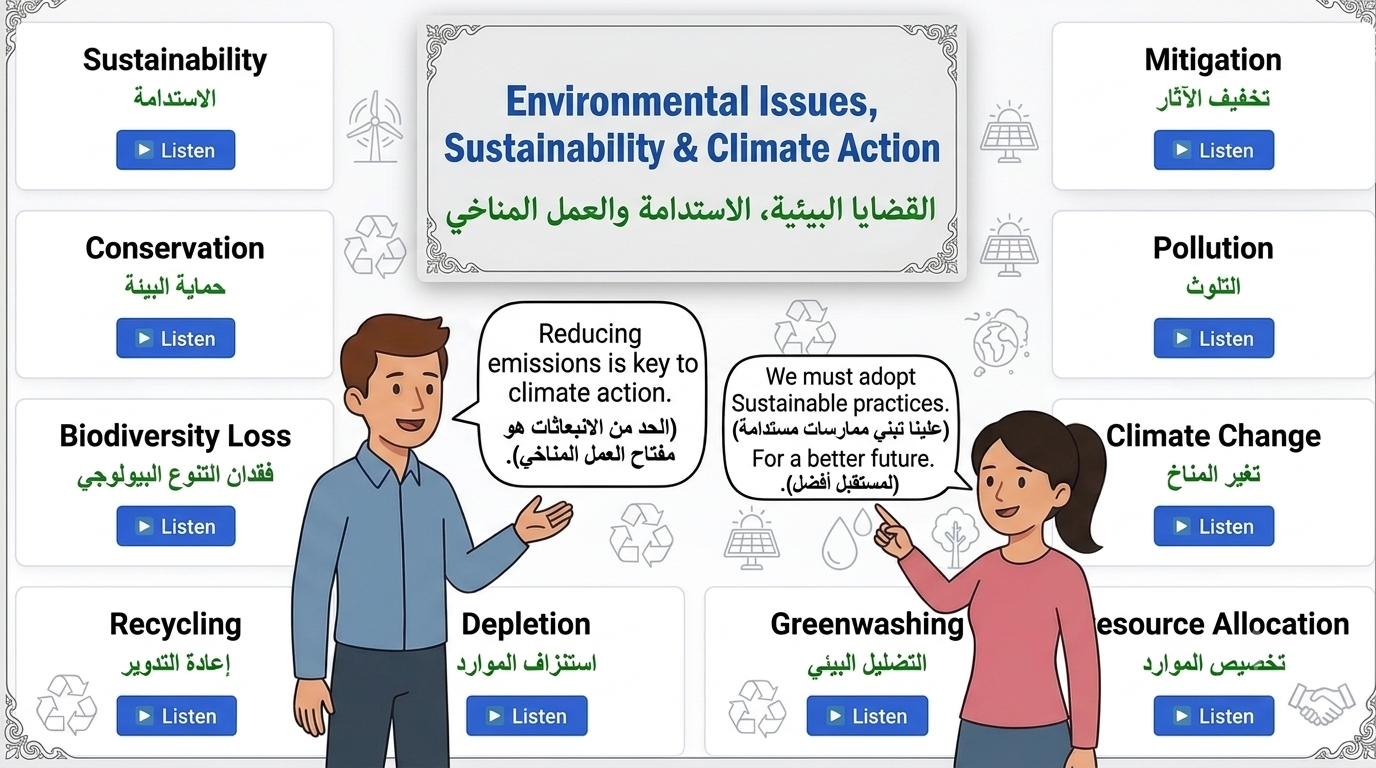
Addressing global environmental challenges (معالجة التحديات البيئية العالمية) requires high-level vocabulary and precise discourse to formulate persuasive arguments (صياغة حجج مقنعة) and articulate sustainable solutions (توضيح الحلول المستدامة). Whether participating in policy forums (المشاركة في المنتديات السياسية), drafting environmental reports (إعداد التقارير البيئية), or evaluating ecological policies (تقييم السياسات البيئية), mastering specialized terminology is imperative. In this advanced lesson, you will analyze eco-centric terminology, examine complex conditional structures for hypothetical policy scenarios, evaluate sustainable framework dialogues, and interact with 15 audio-enabled vocabulary cards.
Grammar Focus: Advanced Conditionals & Inverted Conditionals for Hypothetical Scenarios
When formulating analytical arguments, policy recommendations, or speculative ecological projections, using advanced conditional formulations elevates the academic rigor of your prose:
- 1. Inverted Third Conditionals (قلب الشرط للحديث عن الماضي الإفتراضي):
- Omitting “if” and starting with “Had” creates a formal, elevated tone for discussing past hypothetical outcomes:
- Standard: “If governments had invested earlier in clean energy, emissions would have dropped.”
- Inverted: “Had governments invested earlier in clean energy, carbon emissions would have dropped significantly.”
- 2. Inverted Unreal Conditionals with “Were to” (قلب الشرط للفرضيات المستقبلية):
- Expresses formal, hypothetical future scenarios in policy debates:
- Standard: “If global temperatures were to rise by 2 degrees, sea levels would flood coastal zones.”
- Inverted: “Were global temperatures to rise by 2 degrees, coastal areas would experience unprecedented flooding.”
- 3. Mixed Conditionals for Present Impacts of Past Actions (الشرط المركب):
- Connects an unfulfilled past condition with a present consequence:
- Example: “If industrialized nations had adopted strict regulations decades ago, our ecological status would be far more stable today.”
Navigating Environmental Policy, Sustainability Frameworks & Climate Action
Engaging with global sustainability frameworks requires understanding both technical concepts and institutional discourse:
- Evaluating the Shift to Renewable Energy (تقييم التحول نحو الطاقة المتجددة): The transition from fossil fuels to renewable energy systems involves complex economic and logistical trade-offs. While solar and wind infrastructure reduce carbon footprints (البصمة الكربونية), energy storage efficiency and grid modernization remain critical hurdles that policymakers must navigate strategically.
- Understanding the Circular Economy Model (فهم نموذج الاقتصاد الدائري): Traditional industrial models follow a linear path of extraction, consumption, and disposal. In contrast, the circular economy (الاقتصاد الدائري) focuses on resource efficiency through recycling, remanufacturing, and waste elimination, thereby preventing resource depletion (استنزاف الموارد) and environmental degradation.
- Combating Corporate Greenwashing and Regulatory Challenges (مكافحة التضليل البيئي والتحديات التنظيمية): As environmental stewardship (المسؤولية البيئية) gains consumer priority, organizations face scrutiny regarding greenwashing (التلميع الأخضر)—the deceptive practice of exaggerating ecological efforts. Stringent compliance audits and transparent ESG (Environmental, Social, and Governance) reporting are essential to ensure authentic climate mitigation efforts.
Global Climate Policy Symposium Dialogue Example
Here is a structured intellectual exchange between two environmental policy strategists discussing climate action models:
- Dr. Elena (Environmental Scientist): Had key carbon-emitting industries adopted clean technology earlier, we would not be facing such severe ecological thresholds today.
- Marcus (Policy Analyst): That perspective is valid; however, were governments to impose immediate heavy carbon taxes without subsidies, emerging markets would face significant economic disruption.
- Dr. Elena (Environmental Scientist): I concede that economic transitions require care, but delaying mitigation efforts only exacerbates resource depletion in vulnerable regions.
- Marcus (Policy Analyst): Could we integrate incentives for the circular economy instead of relying exclusively on punitive measures?
- Dr. Elena (Environmental Scientist): Certainly. Combining regulatory mandates with infrastructure incentives ensures sustainable development while maintaining industrial competitiveness.
- Marcus (Policy Analyst): That balanced framework seems optimal. It aligns corporate responsibility with long-term climate stewardship.
📝 تمارين تفاعلية | Practice Exercises – Level 3 : Lesson 4
Lesson Conclusion
Congratulations! You have successfully completed Level 3 – Lesson 4.
In this lesson, you gained advanced mastery over environmental policy and climate action terminology. You integrated 15 critical concepts into your vocabulary: Sustainability, Carbon Footprint, Renewable Energy, Biodiversity, Conservation, Depletion, Mitigation, Ecosystem, Greenwashing, Environmental Degradation, Resource Allocation, Circular Economy, Emissions Offset, Ecological Threshold, and Stewardship. Furthermore, you learned how to articulate complex policy projections using inverted conditionals (Had governments invested…, Were global temperatures to rise…).
- Tip of the Day: Using inverted conditionals like “Had key industries adopted clean tech earlier…” adds high academic rigor to your formal writings and policy presentations!
Fantastic work! See you in Lesson 5.