
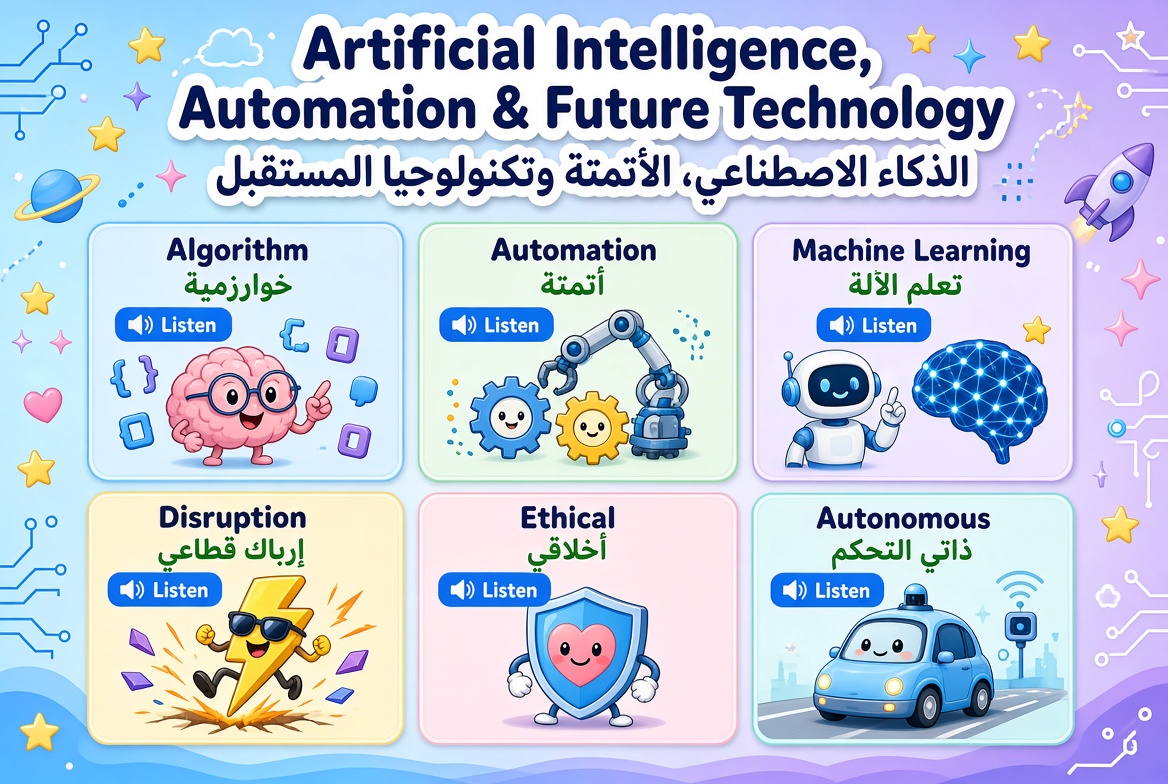
تعلم اللغة الإنجليزية : الدرس السادس – الذكاء الاصطناعي، الأتمتة وتكنولوجيا المستقبل
Navigating complex discourse surrounding artificial intelligence (مناقشة الذكاء الاصطناعي) and technological automation (الأتمتة التكنولوجية) requires sophisticated linguistic precision (دقة لغوية متقدمة) to evaluate societal impacts, ethical dimensions, and future economic paradigms. Whether you are addressing algorithmic bias (التحيز الخوارزمي), human-AI collaboration (التعاون بين الإنسان والذكاء الاصطناعي), or policy regulations (التنظيمات السياساتية), mastering advanced terminology is vital. In this advanced lesson, you will explore 15 audio-enabled vocabulary cards, analyze sophisticated grammar involving nominalization and passive voice nuances, examine high-level contextual discourse, and assess your expertise through 6 interactive exercises.
Grammar & Structure Focus: Nominalization & Advanced Passive Nuances in Tech Policy
In advanced academic and corporate discourse regarding artificial intelligence, formal tone is achieved by transforming verbs/adjectives into nouns (nominalization) and using agentless passive structures:
- 1. Nominalization for Academic Objectivity (صياغة الأسماء للموضوعية الأكاديمية):
- Converting actions into noun phrases shifts focus to abstract concepts and systematic impacts:
- Standard: “Companies automate tasks and displace workers rapidly.”
- Nominalized: “The rapid automation of tasks leads to structural workforce displacement.”
- Standard: “Algorithms bias results when engineers train them on flawed data.”
- Nominalized: “Algorithmic bias stems from flawed data training.”
- 2. Advanced Passive Constructions for Systemic Description (المبني للمجهول المتقدم):
- Use passive forms with modal verbs or reporting verbs to present objective findings or policy standards:
- Form: Subject + Modal + be + Past Participle
- Example: “Ethical frameworks must be implemented prior to commercial deployment.”
- Form: It + Passive Reporting Verb + that clause
- Example: “It is generally acknowledged that regulatory compliance lags behind technological innovation.”
- 3. Subjunctive & Hypothetical Inversion for Future Tech Policy (صيغ الافتراض العكسي):
- Inverted Condition: “Had policymakers anticipated rapid algorithmic scaling, regulation would have preceded deployment.”
- Formal Subjunctive: “It is imperative that data governance be mandated across all cloud architectures.”
Evaluating the Socio-Economic and Ethical Dimensions of Artificial Intelligence
Constructing rigorous academic arguments on technological disruption requires precise structural framing and critical vocabulary:
- Articulating Nuanced Positions (صياغة المواقف الدقيقة): Avoid binary claims (e.g., “AI is good or bad”). Instead, deploy precise qualifiers: “While generative automation enhances productivity metrics (مؤشرات الإنتاجية), it simultaneously introduces critical questions surrounding intellectual property rights and data integrity.”
- Deconstructing Opposing Arguments (تفكيك الحجج المنافسة): Challenge technological determinism by highlighting systemic factors: “Advocates emphasize computational efficiency (الكفاءة الحسابية); however, this argument underestimates the societal cost of widespread workforce disruption.”
- Navigating Disagreements Professionally (إدارة الخلافات باحترافية): Reframe conflicts through policy and governance terminology: “Rather than imposing outright bans, regulatory bodies should focus on algorithmic transparency (الشفافية الخوارزمية) and robust security frameworks.”
Professional Academic Debate Dialogue Example: Ethics of AI Regulation
Here is an advanced academic debate between two technology policy experts regarding algorithmic governance:
- Dr. Aris: The exponential scalability of neural networks necessitates immediate government oversight to prevent systemic algorithmic bias.
- Dr. Vance: While I concede that bias poses legitimate concerns, premature regulation risks stifling technological innovation and global competitiveness.
- Dr. Aris: It is precisely through proactive governance that we ensure human augmentation remains ethical, rather than permitting unvetted deployment.
- Dr. Vance: Should regulatory mandates prove overly restrictive, developers will simply migrate operations to more permissive jurisdictions.
- Dr. Aris: That scenario underscores the urgency for international consensus on baseline safety standards and data privacy frameworks.
- Dr. Vance: Achieving global consensus is ideal; however, flexible industry self-regulation remains the more pragmatic immediate solution.
Lesson Conclusion
Congratulations! You have successfully completed Level 3 – Lesson 6: Artificial Intelligence, Automation & Future Technology.
In this advanced lesson, you mastered 15 academic-level vocabulary terms including Algorithm, Automation, Machine Learning, Neural Network, Bias, Disruption, Ethical, Autonomous, Optimization, Predictive, Computation, Augmentation, Regulation, Scalability, and Paradigm. Furthermore, you examined formal nominalization techniques and agentless passive structures essential for policy papers, tech journalism, and executive discourse.
- Tip of the Day: In formal academic or tech policy writing, substituting verb phrases with nominalized nouns (e.g., using “the acceleration of automation” instead of “automating faster”) elevates the analytical tone and enhances credibility.
Outstanding work! See you in Lesson 7.