
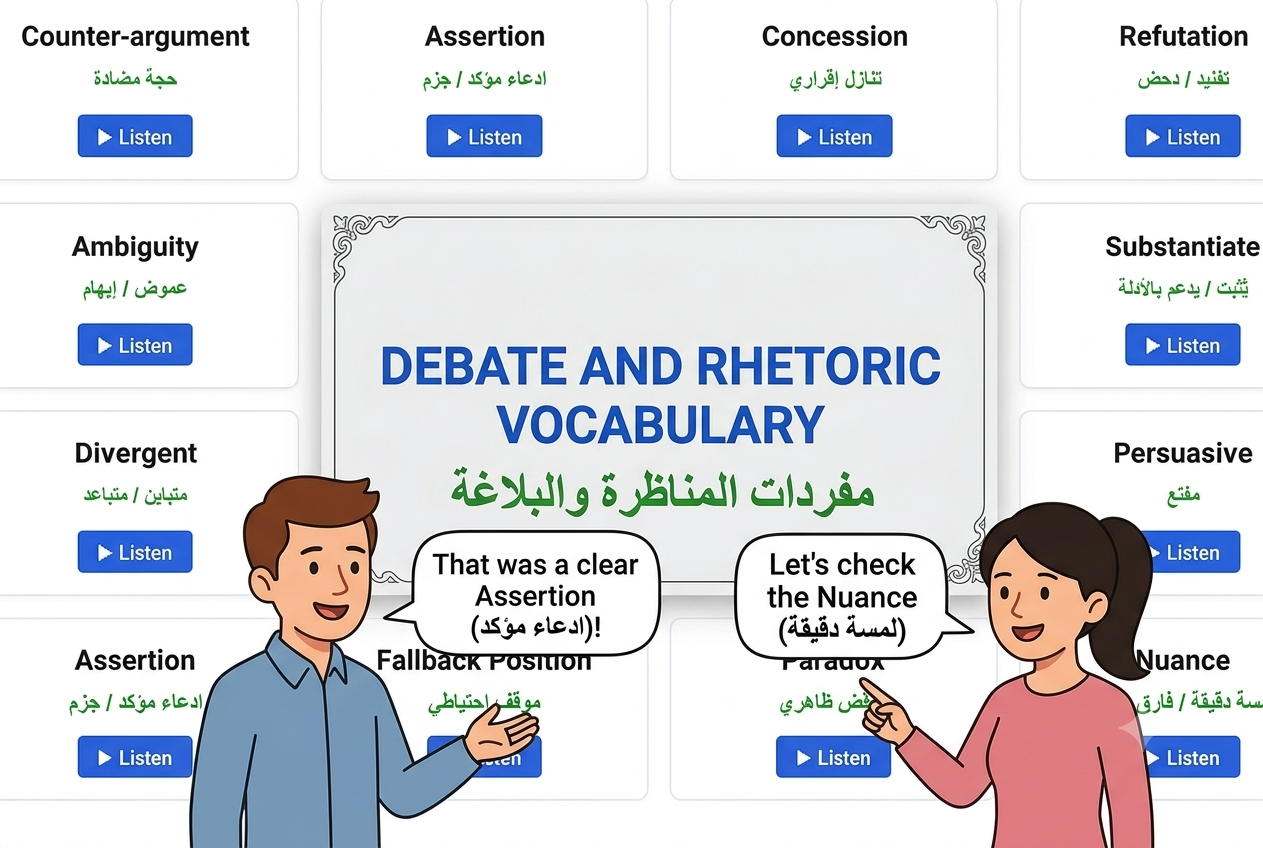
تعلم اللغة الإنجليزية : الدرس الثالث – المناظرات، التعبير عن الآراء والحجج الدقيقة
Engaging in high-level intellectual discussions (المشاركة في المناقشات الفكرية رفيعة المستوى) requires a sophisticated vocabulary that allows speakers to express disagreement respectfully (التعبير عن عدم الاتفاق باحترام) and construct nuanced arguments (بناء حجج دقيقة ومفصلة). Whether you are participating in an academic debate (مناظرة أكاديمية), articulating a strategic business vision (صياغة رؤية تجارية إستراتيجية), or presenting a critical analysis (تقديم تحليل نقدي), mastering persuasive language is vital. In this advanced lesson, you will explore counter-arguments (الحجج المضادة), learn subtle phrasing for polite concessions (التنازلات اللبقة), analyze complex grammar structures, and interact with 15 audio-enabled vocabulary cards.
Grammar Focus: Subjunctive Mood, Inversion & Complex Conditionals
In formal rhetoric and advanced discourse, using sophisticated grammatical structures elevates your argument and projects intellectual confidence:
- 1. Inversion for Emphasis (قلب الترتيب للتأكيد والخطابة):
- When starting sentences with negative or restrictive adverbs (like rarely, seldom, not only, under no circumstances), invert the subject and auxiliary verb to create a powerful rhetorical effect:
- Standard: “We rarely see such a convincing argument.”
- Inverted: “Rarely do we see such a convincing argument.”
- Standard: “He not only refuted the claim, but he also proposed a new solution.”
- Inverted: “Not only did he refute the claim, but he also proposed a new solution.”
- 2. The Subjunctive Mood for Recommendations and Hypotheses (صيغة المنصوب للتوصيات والافتراضات):
- Used in formal contexts to express necessity, demands, or hypothetical conditions using the base form of the verb:
- “It is imperative that the committee review (not reviews) all counter-arguments before voting.”
- “The chairman recommended that she substantiate (not substantiates) her claims with reliable data.”
- 3. Mixed Conditionals for Nuanced Speculation (الشروط المركبة للافتراضات المعقدة):
- Expressing how past decisions affect present conditions:
- “If the research team had addressed that inconsistency earlier (Past Perfect), our current strategy would be much stronger (Present Conditional).”
Framing Perspectives and Structuring Debates
Constructing a compelling argument in advanced English involves more than merely stating personal preferences; it demands logical coherence (الاتساق المنطقي) and strategic language choice:
- Articulating Nuanced Positions (صياغة المواقف الدقيقة): Avoid binary claims (claims that are strictly black or white). Instead, employ qualified expressions such as “To a certain extent…” (إلى حد ما) or “While I concede that X is valid, Y remains superior…” (بينما أقرّ بصحة X، فإن Y يظل الأفضل). This technique highlights critical thinking rather than rigid bias.
- Deconstructing Opposing Arguments (تفكيك الحجج المنافسة): When engaging with a counter-argument (حجة مضادة), demonstrate active listening before offering a refutation (تفنيد). Phrasing such as “That argument carries significant weight; however, it overlooks…” validates your opponent’s view while dismantling its underlying premise (الفرضية الأساسية).
- Navigating Disagreements Professionally (إدارة الخلافات باحترافية): High-level discourse prioritizes diplomacy. Instead of using direct contradictions like “You are wrong,” utilize diplomatic reframing: “I view the situation through a slightly different lens…” or “The available empirical evidence suggests an alternative conclusion.”
Professional Academic Debate Dialogue Example
Here is a structured intellectual debate between two analysts discussing economic strategy:
- Dr. Aris (Analyst A): Not only must we evaluate short-term fiscal returns, but we must also consider long-term environmental consequences.
- Dr. Vance (Analyst B): That assertion is partially valid; however, under no circumstances can we ignore immediate market volatility.
- Dr. Aris (Analyst A): While I concede that market volatility presents temporary challenges, relying solely on immediate gains relies on a flawed premise.
- Dr. Vance (Analyst B): Could you substantiate that claim with empirical data? Our fallback position depends on verified projections.
- Dr. Aris (Analyst A): Certainly. Recent studies demonstrate that companies embracing sustainable rhetoric achieve greater stability over a decade.
- Dr. Vance (Analyst B): That is a persuasive argument. It appears we have reached a partial consensus on the core issue.
📝 تمارين تفاعلية | Practice Exercises – Level 3 : Lesson 3
Lesson Conclusion
Congratulations! You have successfully completed Level 3 – Lesson 3.
In this lesson, you enriched your vocabulary with 15 essential academic and debate terms: Counter-argument, Assertion, Concession, Refutation, Ambiguity, Persuasive, Inconsistency, Substantiate, Divergent, Consensus, Paradox, Rhetoric, Fallback Position, Premise, and Nuance. Masterfully applying these terms allows you to construct compelling, intellectual, and diplomatic arguments in any formal setting.
- Tip of the Day: Elevate your debating skills by using substantiate whenever you back up an assertion, and always address a counter-argument with a respectful concession before providing your refutation.
Outstanding progress! See you in Lesson 4.